
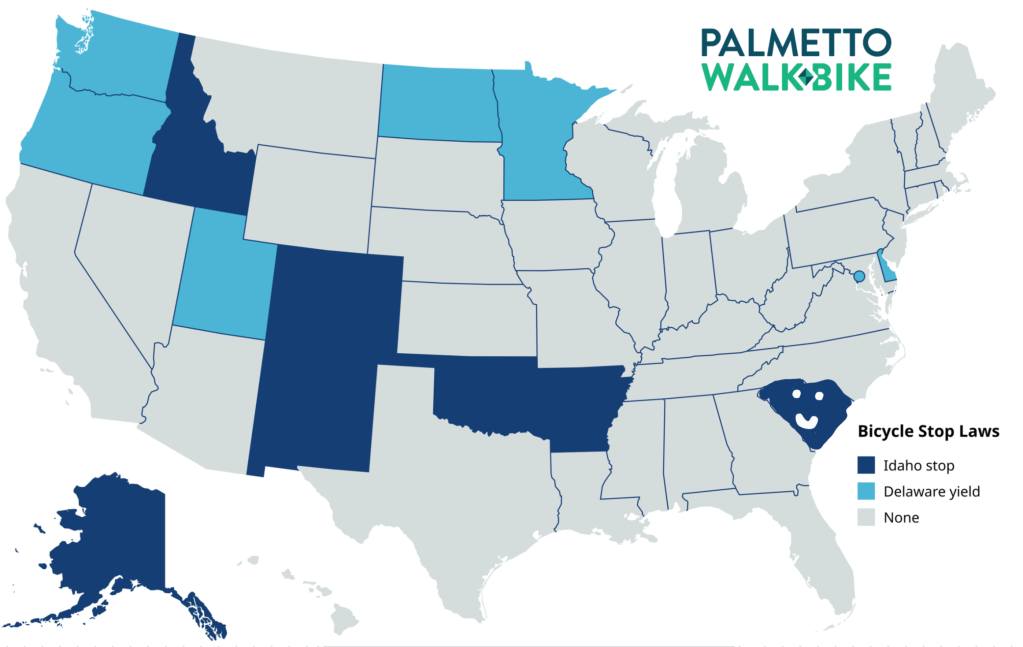
South Carolina’s Stop as Yield Bicycle Law
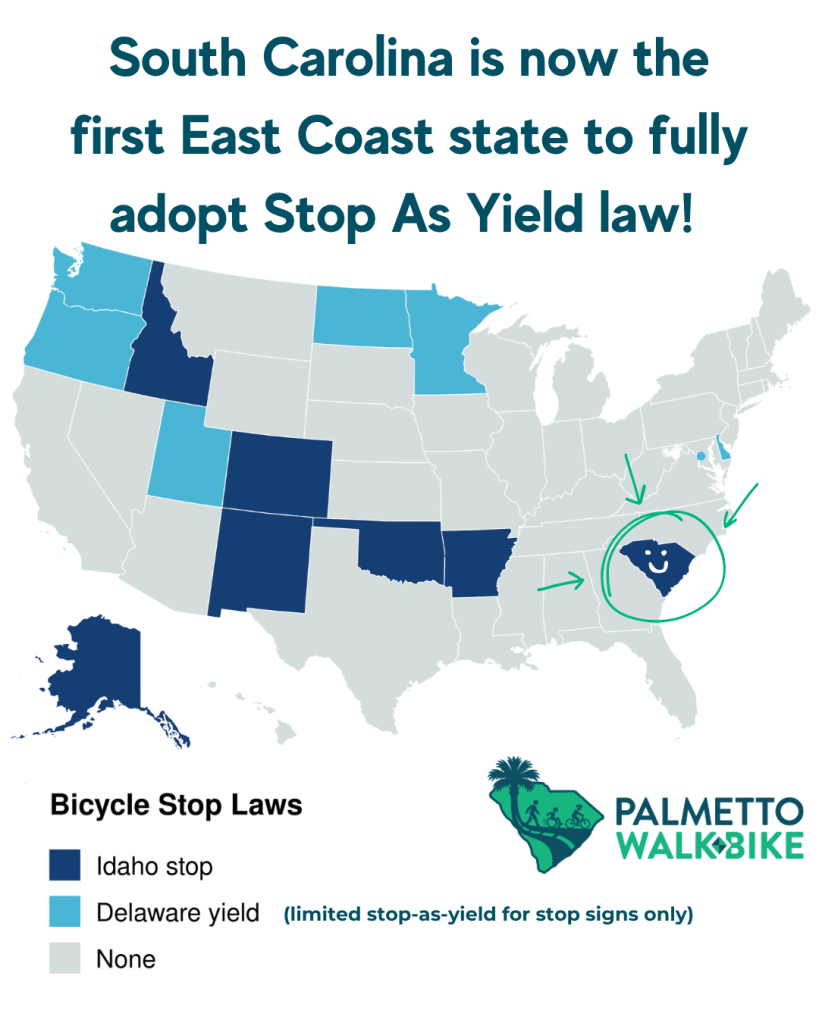
In May 2026, South Carolina became the first state on the East Coast to fully adopt Stop as Yield legislation for people riding bicycles.
Palmetto Walk Bike was proud to lead the effort to get the law passed.
Along the way, we coined the name “Palmetto Stop” for South Carolina’s version of the policy, and the name stuck. It was picked up by lawmakers, advocates, media outlets, and communities across the state as the bipartisan legislation moved forward.
What is Stop as Yield?
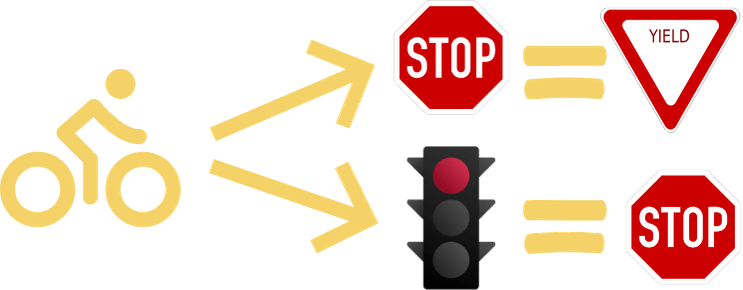
Stop as Yield recognizes that bicycles and motor vehicles operate differently and allows a person on a bicycle to safely navigate an intersection accordingly.
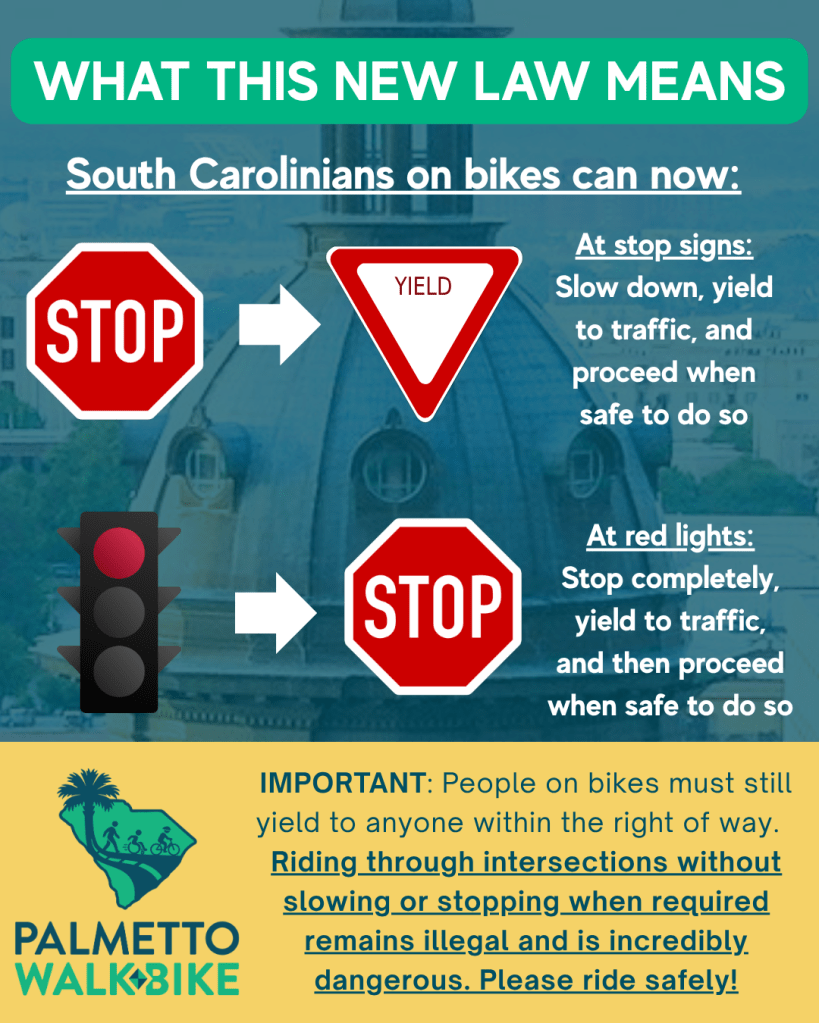
At a Stop Sign
Allows a person riding a
bicycle to treat a stop
sign as a yield sign,
slowing down and yielding to any traffic
before continuing when
safe to do so.
At a Red Light
Requires a person riding
a bicycle to come to a
full stop at a red light,
but allows them to
proceed when the
intersection is clear and
it is safe to do so.
A Palmetto Stop is only appropriate when it can be made safely.
Just because you can Palmetto Stop does not mean you always should.
Idaho Stop 🤝 Palmetto Stop
South Carolina did not invent this idea.
Idaho became the first state to allow people on bicycles to treat stop signs as yields in 1982, which is why Stop as Yield is often called the Idaho Stop. The policy is also commonly known as the Bicycle Safety Stop.
In the decades since, more states have adopted versions of the policy, giving researchers an opportunity to study its safety impacts.
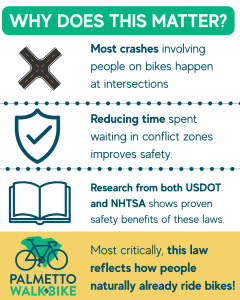
The National Highway Traffic Safety Association (NHTSA) reports that bicycle injuries in Idaho declined 14.5% the year after the state adopted its law. When Delaware adopted a similar law in 2017, crashes involving people on bicycles at stop sign controlled intersections declined 23% during the following 30 months compared with the previous 30 months.
Why Stop as Yield?
One simple reason: intersections are among the most dangerous places for people riding bicycles. Stop as Yield allows riders to move through a clear intersection safely, reducing their time in potential conflict with motor vehicles.
Importantly, it also recognizes that bicycles operate differently than cars. Riders rely on momentum, move at lower speeds, and often have better visibility of approaching traffic.
South Carolina had another reason for the change: many traffic signals do not detect bicycles.
Under the state’s existing “Dead Red” law, bicycle riders had to wait 120 seconds before proceeding through an unresponsive red light (note: that 120 second requirement still remains for both motorcycles and mopeds!). The Palmetto Stop replaces that requirement for people riding bicycles with a simpler, safer approach.
How We Got It Done
One of the most important decisions PWB made was how we framed the proposal.
The Palmetto Stop was essentially a code update.
As shared above, South Carolina already had bicycle specific provisions in its traffic code, including the 120 second “Dead Red” rule for traffic signals that failed to detect bicycles. The Palmetto Stop offered an opportunity to update those rules based on how bicycles actually operate and policies that had already been tested in other states.
That framing helped keep the conversation focused on what the legislation actually did: establish clear rules for when a person on a bicycle must stop, when they must yield, and when they may safely proceed.
PWB worked with local and regional bicycle organizations, community partners, and advocates from across South Carolina to demonstrate broad support for the change.
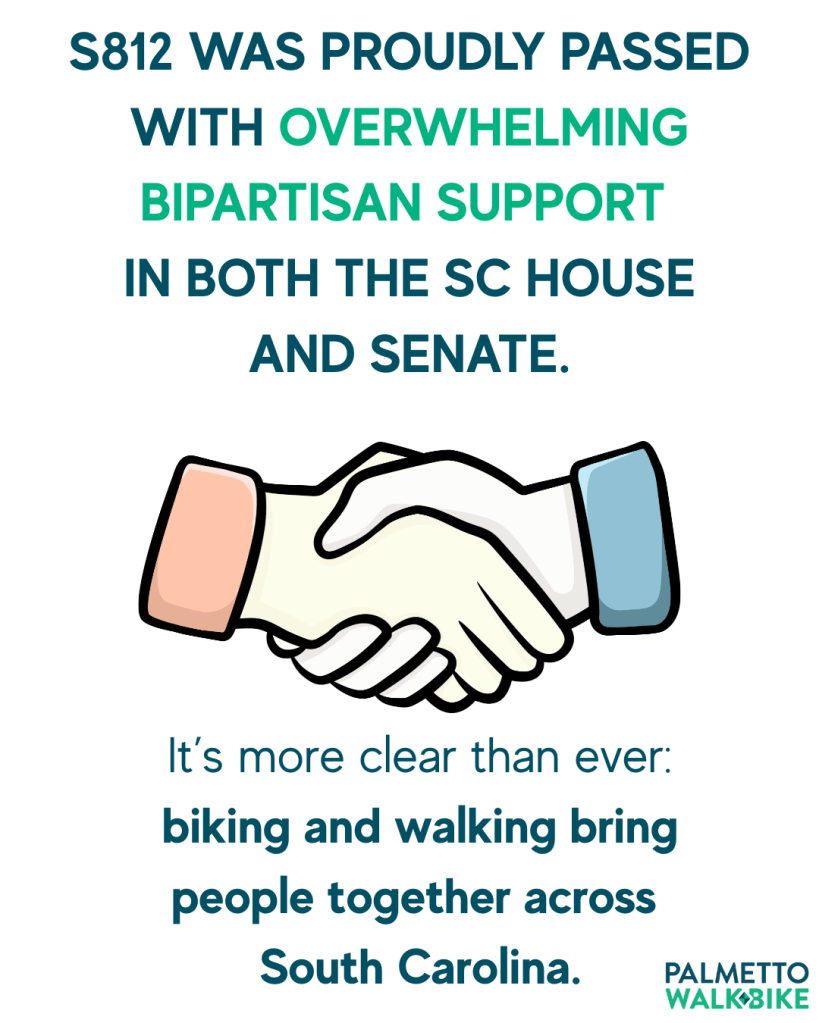
That statewide support was matched by bipartisan support at the State House.
Senator Luke Rankin introduced S.812 in January 2026. The bill passed the Senate 42 to 2 and the House 93 to 18 before being signed into law by Governor Henry McMaster in May 2026.
From introduction to becoming law, the Palmetto Stop took just a few months.
Built on Research
The Palmetto Stop was not a new or untested idea. PWB was able to point lawmakers and partners to decades of experience from other states and research from federal transportation safety agencies.
The National Highway Traffic Safety Administration has examined Stop as Yield laws and documented their safety benefits, including the experiences of Idaho and Delaware.
Federal transportation research also helps explain why these policies can improve safety by recognizing the unique operating characteristics of bicycles and reducing unnecessary exposure at intersections.
Federal Research & Resources
National Highway Traffic Safety Administration
Bicyclist Stop as Yield Laws and Safety
A federal fact sheet summarizing Stop as Yield laws, existing research, and safety findings from states including Idaho and Delaware.
Federal Highway Administration
Stop as Yield Law Analysis
A federal analysis examining Stop as Yield laws and available safety data.
Want to keep a copy or share these resources?
Learn More
Download our Palmetto Stop Guide for a quick explanation of the law, how it works, and why it can improve safety.
You can also read media coverage about the passage of the Palmetto Stop here.
Graphics we created to inform our community are attached below.
Moving South Carolina Forward
The Palmetto Stop is a practical change, backed by research and made possible by broad support from communities and lawmakers across South Carolina.
PWB is proud to have led the effort and grateful to the local and regional partners, advocates, and bipartisan group of lawmakers who helped turn an idea into state law.
Most of all, the Palmetto Stop shows that South Carolina can lead on policies that make our streets safer and work better for people walking, biking, and rolling. We look forward to building on it.
 Palmetto Walk Bike